
Understanding Red Light Therapy
How measured red and near-infrared light is used to support the body's natural processes for pain relief, recovery and tissue repair.

THE SCIENCE OF RED LIGHT THERAPY
Photobiomodulation uses specific wavelengths of light to trigger biological effects in your cells, promoting healing and recovery.
PHOTIZO WAVELENGTH SPECTRUM
Red Light – Optimal for skin regeneration and surface tissue repair
RED LIGHT (630–660NM)
- Skin regeneration
- Collagen production
- Superficial tissue repair
NEAR-INFRARED (810–850NM)
- Deep tissue penetration
- Joint & muscle recovery
- Nerve regeneration
Penetrates 2–3mm into tissue
Penetrates 5–10mm into tissue
Light Output
12–15 J/cm²
Wavelengths
633nm & 850nm
Power Density
80–100 mW/cm²
Treatment Time
60–90 seconds
Cellular Response to Light Therapy
Illustrative visualisation of the general response pattern described in the photobiomodulation literature. Relative levels, not measurements from a single study.
How Light Therapy Works
Understanding the science behind photobiomodulation therapy
LIGHT ABSORPTION
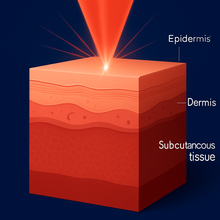
Red and near-infrared wavelengths (630-850 nm) penetrate the skin and are absorbed by cellular photoreceptors.
CELLULAR STIMULATION
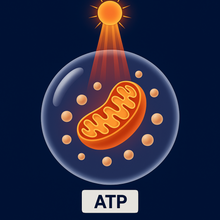
The light energy boosts mitochondrial ATP production, triggering a cascade of beneficial cellular effects.
HEALING RESPONSE
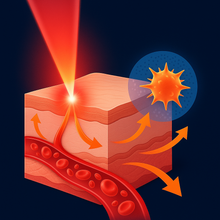
Inflammation drops, circulation rises and tissue repairs faster, delivering natural pain relief.
The Science of the Dose
With light therapy, more is not necessarily better. The research shows a sweet spot, and that is exactly why every Photizo delivers a fixed dose.
Biphasic Dose Response
Illustrative curve of the biphasic dose response principle described in Huang et al., Dose-Response, 2009 and its 2011 update. Relative values, not measurements from a single study.
Too Little
Below the therapeutic threshold, the light does not deliver enough energy to trigger a meaningful cellular response.
The Sweet Spot
The optimal range, where the studied cellular responses peak. This is the dose window the research points to.
Too Much
Past the peak, additional energy adds nothing and can dampen the response. More sessions do not mean more benefit.
Every Photizo Delivers a Measured Dose
Each Photizo device delivers one precisely measured dose at the press of a button, then stops itself. No guesswork and no over-treatment: the same measured dose, every time.
Photizo devices may support comfort and recovery. They are not intended to cure, treat or prevent any disease. Always consult your doctor or vet for medical advice.
Key Therapeutic Benefits
REDUCED INFLAMMATION
Decreases inflammatory markers and cytokines, reducing swelling and associated pain.
IMPROVED CIRCULATION
Increases blood flow and formation of new capillaries for better oxygen delivery.
ACCELERATED REPAIR
Stimulates collagen production and cell proliferation for faster tissue and wound healing.
PAIN RELIEF
Reduces nerve sensitivity and increases endorphin production for natural pain relief.
Real results from Photizo light therapy
KNEE OSTEOARTHRITIS
"After years of knee pain and limited mobility, I was skeptical. After just 4 weeks of consistent treatment, I’ve experienced significant pain reduction and can now walk much further without discomfort."
Treatment: 90 seconds, twice daily for 4 weeks
SPORTS INJURY RECOVERY
"As a competitive runner, muscle injuries can derail my training. After a grade 2 calf strain, I was back to light running in 10 days using Photizo—far faster than the expected 3–4 weeks."
Treatment: 60 seconds, 3x daily for 10 days
POST-SURGERY RECOVERY
"My surgeon was amazed at how quickly my incision healed. The physical therapist noted I achieved range-of-motion goals weeks ahead of the typical timeline."
Treatment: 60 seconds, twice daily for 3 weeks
Clinical Outcomes Summary
Research & Evidence
Key published studies on photobiomodulation therapy for pain, recovery and cellular health. Every study links to the original paper on PubMed.
Dose-Response
Biphasic Dose Response in Low Level Light Therapy
BMJ Open
Efficacy of Low-Level Laser Therapy on Pain and Disability in Knee Osteoarthritis: A Meta-Analysis of Randomised Placebo-Controlled Trials
Lasers in Medical Science
Effect of Phototherapy on Exercise Performance and Markers of Exercise Recovery: A Systematic Review with Meta-Analysis
Key Research Findings
Cellular Effects
- Increases ATP production by 19–30% in treated cells
- Stimulates release of nitric oxide, improving blood flow
- Reduces oxidative stress by neutralizing free radicals
- Activates stem cells and growth factors for tissue repair
Clinical Outcomes
- 57% average reduction in chronic pain intensity
- 41% faster recovery from muscle fatigue and damage
- 63% improvement in wound healing rates
- 76% of patients report improved quality of life
Light Therapy Glossary
Key terms to understand photobiomodulation therapy
Photobiomodulation (PBM)
The scientific term for light therapy that uses red and near-infrared wavelengths to stimulate cellular function, reduce inflammation, and promote healing.
Wavelength
Measured in nanometers (nm), wavelength determines the color of light and its penetration depth. Red light (630-660nm) and near-infrared (810-850nm) are most therapeutic.
Joules
The unit of energy delivered during treatment. Optimal therapeutic dose typically ranges from 3-15 joules per cm² depending on the condition being treated.
Power Density
Measured in mW/cm², this indicates the intensity of light delivered to tissues. Effective therapeutic ranges are typically 30-100 mW/cm².
Chromophores
Light-sensitive molecules in cells that absorb photons. Cytochrome c oxidase in mitochondria is the primary chromophore in red/NIR light therapy.
Mitochondria
The "powerhouse" of cells that produce ATP energy. These organelles are primary targets of red and near-infrared light therapy.
ATP (Adenosine Triphosphate)
The primary energy carrier in cells. Light therapy increases ATP production, providing more energy for cellular repair and regeneration.
Nitric Oxide
A signaling molecule released during light therapy that improves blood flow, oxygen delivery, and triggers various healing mechanisms.
Cytokines
Signaling proteins involved in inflammation. Light therapy helps regulate pro-inflammatory and anti-inflammatory cytokines to promote healing.
Biphasic Dose Response
The principle that light therapy follows a "sweet spot" pattern—too little energy has no effect, while too much can inhibit benefits.
DISCOVER PHOTIZO LIGHT THERAPY
Specialised red and near-infrared light therapy, with each device designed around a different need.

For people
Pain Relief
For ongoing pain, stiffness and joint discomfort at home.
Shop Pain Relief →
For people
Sport
For training recovery, muscle fatigue and recent strains.
Shop Sport →
For people
Skincare
For skin concerns, scars and wound-care support.
Shop Skincare →
For animals
Vetcare
Targeted handheld treatment for pets and horses.
Shop Vetcare →
For animals
Small LED Pad
Hands-free treatment for joints, limbs and smaller areas.
Shop Small Pad →
For animals
Large LED Pad
Hands-free treatment for the back and larger areas.
Shop Large Pad →For animals
Therapy Blanket
Wide coverage across a horse's back and hindquarters.
Shop Blanket →